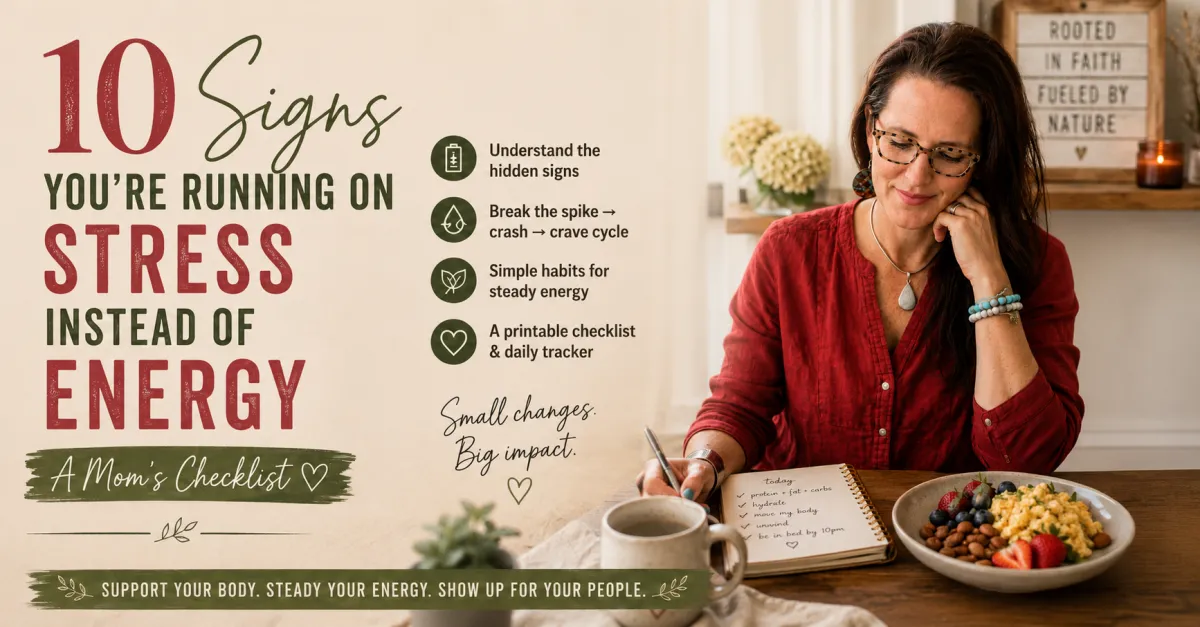
10 Signs You're Running on Stress Instead of Energy: A Mom’s Checklist
The other morning, it was only 10:00 AM. I had eaten what I thought was a totally solid breakfast, yet there I was, standing in front of the refrigerator, staring at the contents, wondering how on earth I was genuinely starving again.
When I actually looked back at what I’d eaten, I realized the truth: I thought I did my due diligence, but I had really just half-assed my way through breakfast. I grabbed something quick to get on with the day, and my body was already paying the price.
Since we homeschool, my kids and I spend a lot of our days together. So when my blood sugar tanks or my energy falls off a cliff in the afternoon, I don't have the option of powering down for a while.
Life keeps moving.
And I've learned the hard way that what I eat at breakfast often determines how the rest of my day unfolds.
So when the infamous 3 PM wall shows up, I have to pay attention.
If I don't stop and figure out what's actually going on, the rest of the day tends to unravel in a hurry.
Over the years, I've learned some hard-won lessons about my metabolism and how my body responds to both internal and external stress. Having a baby at 41 was especially eye-opening. It showed me just how resilient the human body can be, but it also taught me how quickly things can start unraveling when the basics aren't in place.
What I've learned is that a slow metabolism and a stressed metabolism often look exactly the same from the outside.
The deep fatigue.
The relentless cravings.
The short fuse.
The weight that won’t budge.
The brain fog.
The desire to crawl back into bed by mid-afternoon.
The symptoms are nearly identical, but what's happening underneath can be very different.
A truly sluggish metabolism may need more support to increase energy production.
A stressed metabolism is a body that has spent too much time adapting.
Adapting to poor sleep, skipped meals, chronic stress, and constantly being needed by someone else.
Eventually those adaptations start showing up as symptoms.
The problem is that modern life makes it incredibly easy to stay stuck there.
Between the constant demands on our time, grabbing whatever food is closest when we're busy, blood sugar spikes and crashes, poor sleep, and the never-ending mental load most women carry, many of us end up trapped in what I call the Spike → Crash → Crave cycle.
Blood sugar rises.
Blood sugar falls.
The body sounds the alarm.
Suddenly we're hunting for coffee, chocolate, chips, or anything else that promises a quick hit of energy.
And then we do it all over again a few hours later.
It's exhausting in a way that an extra hour of sleep can't fix.
So how do you know if that's what's really going on beneath the surface?
Here's what I've learned to look for.
The Checklist
1. You're starving by 10 AM, even after breakfast. If you're looking for a snack an hour or two after eating, it’s not a lack of willpower. It’s a physical sign that your blood sugar spiked and dropped before your day even really got moving.
2. The 3 PM wall hits like a physical blow. Every single day, right when you need to be "on" for the after-school rush or dinner prep, your energy completely evaporates. Your body is running entirely out of fuel after a morning of invisible crashes.
3. You wake up tired, no matter how many hours you slept. Waking up groggy and heavy usually means your system didn't get into that deep, restorative sleep zone, often because your blood sugar was swinging wildly while you were asleep.
4. Cravings hit hardest after dinner, when you're too tired to fight them. Late-night cravings are the clearest sign of a depleted system. Your body is exhausted and asking for a quick, easy hit of energy because it's running on empty.
5. The scale won't budge, especially around your middle. When you're putting in the effort and seeing zero results, it’s heartbreaking. But when that stubborn weight stays primarily around the belly, it’s usually a stress-hormone response holding onto fat for protection. When that stubborn weight settles primarily around the middle, it's often a sign that your body doesn't feel particularly safe. It’s a safety response, not a math problem with calories.
6. You go from fine to furious in sixty seconds flat. That moment where we snap at our kids over a tiny spill? It’s rarely about the juice. Blood sugar crashes hit your mood and your patience directly. It's chemistry, not bad parenting.
7. You can't function without coffee, and you crash without it. Needing a morning cup is normal. But needing caffeine to avoid a headache, shaky hands, or intense brain fog means your body is relying on a stimulant to cover for an energy system that is maxed out.
8. You're "tired but wired" at night. You drag yourself through the day, but the second your head hits the pillow, your brain turns on. It’s a classic flipped rhythm—stress hormones spiking when they should be winding down, and lagging when you actually need to wake up.
9. If a meal runs late, you completely unravel. Feeling shaky, dizzy, or genuinely "hangry" if lunch is 20 minutes late is a major red flag for blood sugar instability. A resilient energy system can handle a delayed meal without falling apart.
10. You're running on fumes because you can't stop. This is just the honest truth of motherhood. Even after a weekend, a vacation, or a good night's sleep, you still feel like you're playing catch-up. That's often a sign that your body isn't struggling with a lack of motivation. It's struggling with a lack of recovery.
The reality is that many moms are carrying an incredible load with very little built-in recovery time.
What I Do to Keep My Energy Steady
If you checked off three or more of these, it may be time to pay attention.
These aren't random symptoms showing up out of nowhere. More often than not, they're clues that your body is working harder than it should have to.
I had to stop guessing and start being incredibly intentional about how I support my system. Here is the exact, practical checklist of things I do every single day to keep my blood sugar steady and my body out of that constant stress loop.
1. My Daily (Needle Free) Metabolic Support Products
NingXia Red: I drink this daily because it feeds my cells, helps keep blood sugar steady, and keeps me energized. I've learned it's most helpful when I drink it before I hit that afternoon wall, rather than trying to recover after I've already crashed. It comes in 2oz packets that are perfect to grab-and-go.
MultiGreens & Mineral Essence: When your body is stressed, it burns through vitamins and minerals at a massive rate. These are my non-negotiables for putting back what the daily grind takes out.
Super Magnesium: I take this right before bed. It acts as a physical signal to my body that it’s safe to wind down, helping me get actual, restorative sleep instead of waking up groggy.
You can grab my stack HERE
2. The PFC Meal Method
I stopped eating naked carbs or skipping meals. Making a conscious effort to ensure my meals always contain a balance of Protein, Fats, and Carbs (PFC) made a massive, immediate difference in how long my energy lasts.
3. Proactive Planning
I don't leave my meals to chance anymore, because when I’m starving, I make bad choices. If I know I’m going to be out running errands or with the kids, I either pack my food in advance or know exactly where I can stop to get something healthy. No guessing, no letting myself run on empty.
4. Resigning as the "One-Woman Band"
On a practical level, you cannot fix a stressed metabolism if you are running yourself ragged trying to do everything alone. I had to learn to ask for help. My husband and I work together to manage the load so that I'm not carrying the entire house on my back.
5. Prioritizing Bedtime & Unwinding
When the kids go to sleep, the hustle stops. I prioritize my bedtime and protect that little window of time after they are down to just relax, disconnect, and let my nervous system reset before I go to sleep. I am also very intentional about the time I go to bed. You’ll rarely see me up past 10pm.
Download the Checklist & Tracker
Here's what I've learned after years of raising kids, working in animal health, studying nutrition, and paying attention to my own body:
Symptoms rarely show up out of nowhere.
More often than not, they're clues.
The challenge is learning how to listen.
I’ve put all of this into a simple, one-page printable guide. It includes the 10-sign checklist so you can track your own energy dips, plus my daily PFC and supplement tracker so you can start checking off these steady-energy habits yourself.
