Working With Nature: Why I Scrambled My Approach to Fly Season
Yep, it’s that time of year again. We just got a few days of rain here in Northern Illinois, and holy balls, the humidity switch has been officially flipped. It’s like breathing water the second you step outside.
With that wonderful change of events, the horses have started the endless tail-swishing and making a mad dash for the run-in shed. Our herd is on the more senior end of the spectrum, and the last thing I want is for them to waste precious energy just trying to escape the bugs.
If you're in the same boat, you’ve likely found yourself standing in the equine aisle at Farm & Fleet or Tractor Supply, staring down a wall of rainbow-colored bottles, desperate to find something to take the pressure off. I can't tell you how many times I’ve stood there with a bottle in each hand, wondering what the long-term effects of these chemicals actually are on a horse's skin.
But growing up around animals taught me one major lesson: if you want to solve a problem, you have to understand it first. So, before I start mixing up this year's batch of homemade fly spray, let's look at the bugs themselves.
The Unstoppable B-52s
First, let's address the elephant in the pasture: those massive, B-52 bomber horse flies. The ones with actual mandibles instead of stingers? Absolute nightmare fuel. My mare can hear them coming from halfway across the pasture and she’s not a fan.
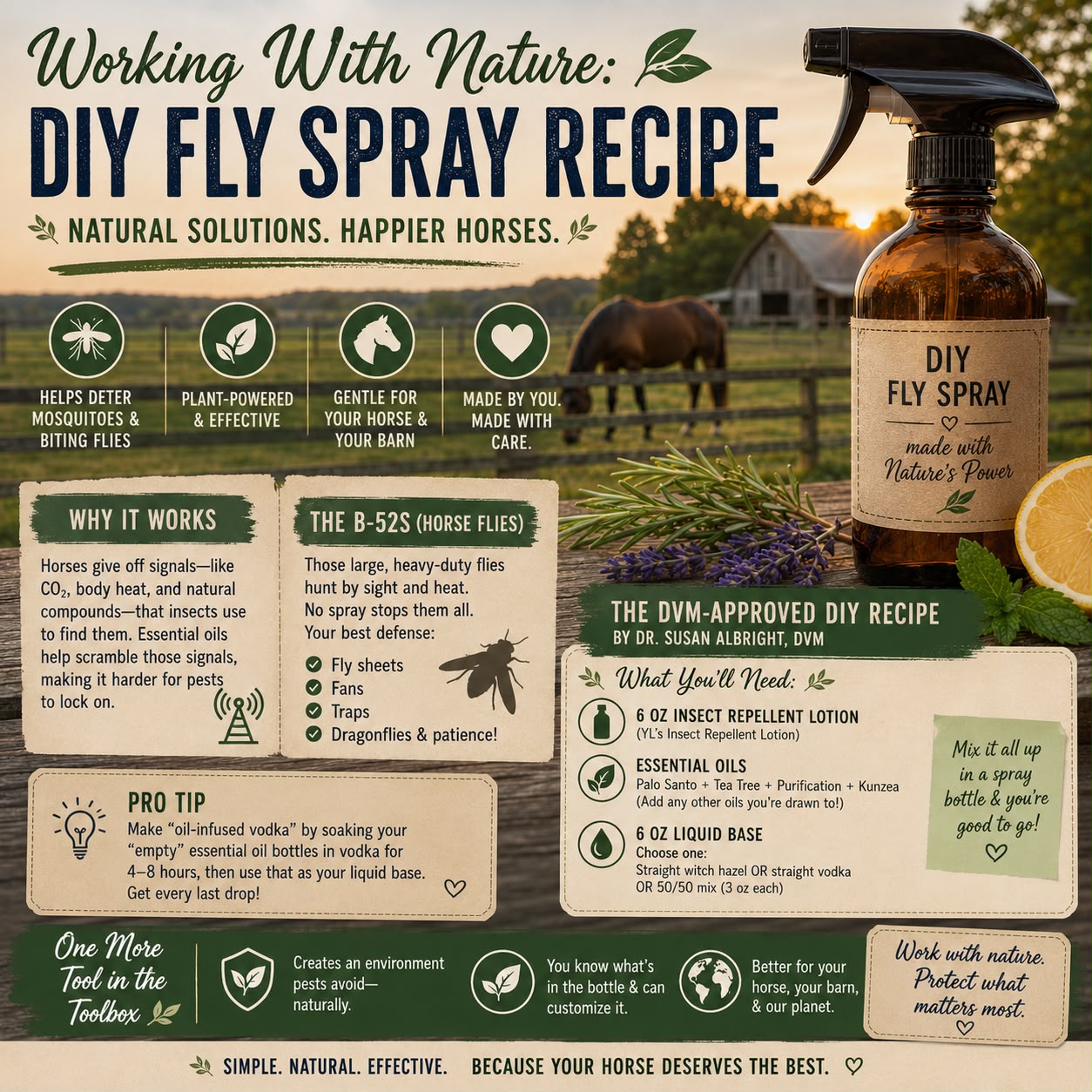
Here is the hard truth: there really isn't a fly spray on the market that does a damn thing against them. They hunt by sight and heat, essentially tiny, winged, heat-seeking missiles. Your best defense isn't in a bottle; it’s fly sheets, industrial-strength fans, traps, and praying a flock of dragonflies moves into your pasture.
How Pests Actually Find Your Horse
But what about the rest of the pests? The mosquitoes, gnats, deer flies, and standard biting flies?
Most people assume bugs just wander around aimlessly until they bump into an animal. But it’s way more calculated than that. Every horse is constantly broadcasting their location:
Every breath releases carbon dioxide.
Their skin secretes natural compounds.
Their body heat creates a literal scent signature they pick up from shockingly far away.
(Honestly, this goes for all of us mammals, but I’m only making fly spray for horses today! 😂)
Basically, our horses are standing in the pasture yelling, "Hey! Over here! Free buffet!" all day long.
The "Radio Static" Approach
And that is exactly why I became such a fan of essential oil-based fly sprays.
Look, we talk a lot about avoiding unnecessary chemicals, but let’s be real, if essential oils didn't actually work, none of us would waste our time or money on them.
Oils like citronella, peppermint, lavender, eucalyptus, and tea tree contain heavy aromatic compounds that bugs hate. But instead of trying to chemically poison the insect, these plant compounds scramble the signals the bugs use to find a host.
Think of it like static on a radio station. The horse is still there, but the bugs can no longer lock onto the signal. Instead of just spraying harsher chemicals and hoping for the best, it’s about understanding how nature works and using it to your advantage.
The Secret Recipe (From Dr. Susan Albright, DVM)
If you’ve been in the oil world for a minute, you might remember Young Living's old Repel Aroma Spray. It was legendary, but it got retired. I recently saw a post from Dr. Susan Albright, DVM, breaking down exactly why it disappeared, and, more importantly, how we can recreate that magic safely.
Turns out, the original formula used Idaho Tansy, which YL stopped producing because its distillation process releases thujone. While thujone is incredible at repelling bugs, the steam during distillation can cause dizziness in humans, and the oil itself can cause skin irritation.
But alas, I have good news! Dr. Albright shared the ultimate workaround to recreate a safe, fantastic spray alternative using YL’s current Insect Repellent Lotion (which is already packed with Citronella, Lemongrass, Rosemary, Geranium, Spearmint, Thyme, and Clove).
The DVM-Approved DIY Solution:
Take 6 oz of the Insect Repellent Lotion
Add Palo Santo + Tea Tree + Purification + Kunzea (plus any other oils you feel drawn to use)
Add 6 oz of a liquid base (either straight witch hazel, straight vodka, or a 50/50 mix of 3 oz each)
Mix it all up in a spray bottle, and you have a powerhouse alternative.
PRO TIP: Want to level up? Dr. Albright recommends making an "oil-infused vodka" by soaking your "empty" essential oil bottles in vodka for 4 to 8 hours, then using that as your liquid base. Talk about getting every last drop!
One More Tool in the Toolbox
For years, the conventional response to bugs getting resistant was just to make the chemicals stronger and spray more often. Plus, you have to deal with that harsh, chemical cloud hitting you in the face. I mean, ick! If the wind catches it, we are breathing those chemicals right in along with our horses.
Does this recipe make your horse 100% invisible? No, but it creates an environment that mosquitoes and biting flies actively avoid, and that’s a win in my book. I know exactly what’s in the bottle, I can tweak it for what each horse needs, and I get to use the power of plants as another tool in my toolkit.
Sometimes the best solutions come into play when we can slow down and pay attention, understand the mechanics, and start working with nature.
Want to mix up your own batch before the next wave of humidity hits? I’ve put together a wishlist with the exact Young Living oils and products from this recipe so you don't have to hunt them down.
Plus, you can use my special discount code SHAREYL for 10% off your purchase!
👉 Grab my favorites HERE
I’d love to hear from you guys in the comments, what’s actually moving the needle in your barn this fly season? Do you mix your own, or do you have a holy grail management setup?
